
The Big Picture
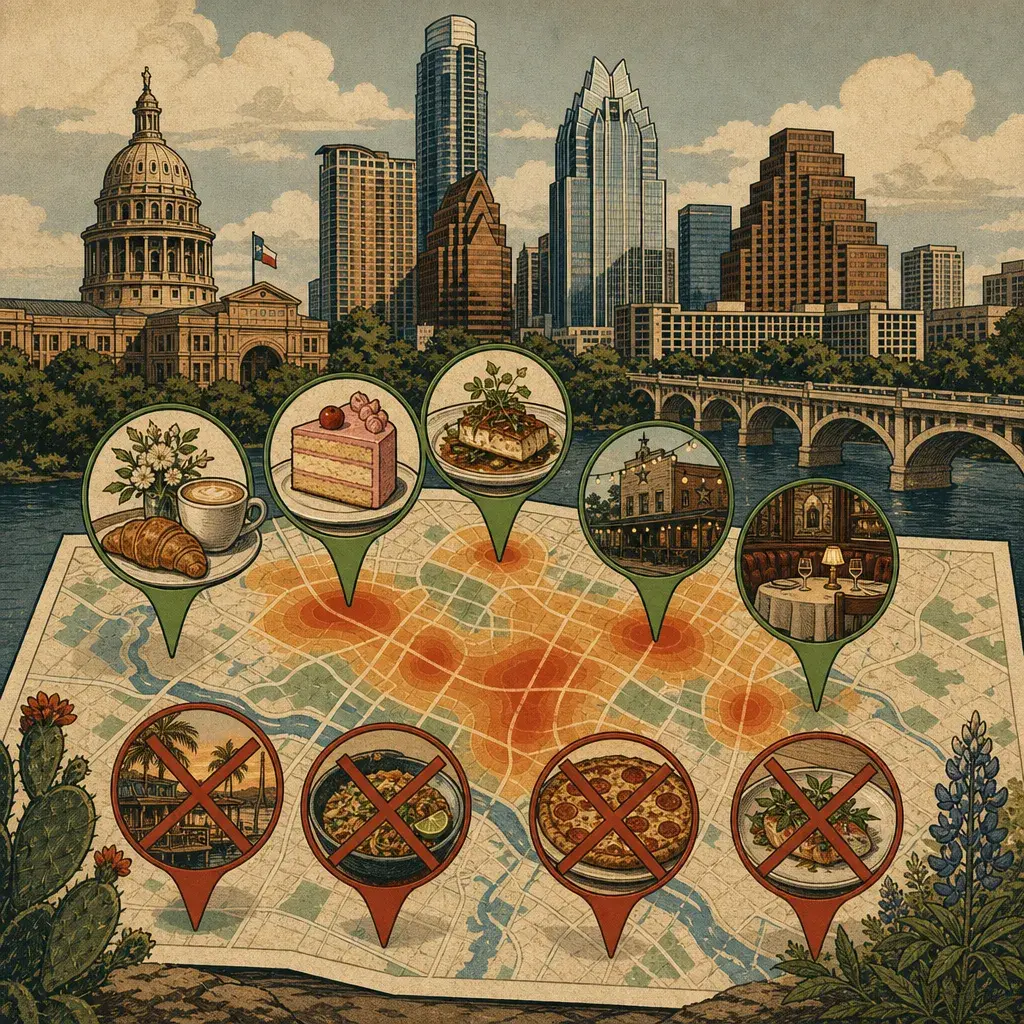
Late capitalism produces two things: an endless stream of new restaurants and an equally reliable inventory of retirements. Eater Austin just rebalanced that ledger. The site updated its local “heatmap,” adding an assortment of openings and relaunches — French bistro Alice Poulain Cafe, gluten-free bakery Sweet Charli Girl, Vietnamese-Texan spot Cui, casual Italian Howdy’s, and the revamped Driskill Grill — while removing several previously listed spots including Twin Isle, Kiin Di, Small’s Pizza, and Kappo Kappo. If you’re trying to parse where to spend your money and attention tonight, the map did some of your emotional labor for you.
By the Numbers
5 New or newly featured entries on Eater Austin's heatmap (Alice Poulain Cafe; Sweet Charli Girl; Cui; Howdy’s; Driskill Grill revamp). 4 Named departures from the map in this update (Twin Isle; Kiin Di; Small’s Pizza; Kappo Kappo). 1 High-profile legacy relaunch — the Driskill Grill returns to the radar after a revamp. Many The unquantified churn that defines Austin dining — openings, pivots, and quiet exits that mean your favorite spot might be next.What Changed
The change is mostly curatorial: Eater refreshed the heatmap to reflect recent openings and re-openings. The additions skew toward variety rather than one trend — a neighborhood French bistro (Alice Poulain Cafe), a specialty gluten-free bakery (Sweet Charli Girl), a hybrid Vietnamese-Texan kitchen (Cui), a casual Italian option (Howdy’s), and a major hotel dining room getting reintroduced (Driskill Grill). The removals suggest either permanent closures, quiet pauses, or editorial pruning; Eater named Twin Isle, Kiin Di, Small’s Pizza, and Kappo Kappo as no longer on the active map. In short: the scene is respinning its playlist.
Why It Matters
This matters tonight because a heatmap is an editorial nudge disguised as data. For diners it trims indecision — new entries mean fresh menus and reasons to leave your couch. For the industry it signals what editors and influencers think is culturally and commercially viable right now: format experiments, niche bakeries, and the continued resonance of legacy hospitality spaces getting facelifts. And existentially? The map is a brief promise that change is possible — or at least that someone is still opening doors.
Between the Lines
There’s a subtext here about who gets space and attention. Specialty spots (gluten-free, fusion concepts) now share the map with hotel stalwarts, which suggests both the democratization of culinary niches and the staying power of branded hospitality. Meanwhile, named removals remind us that curation is also about forgetting.