
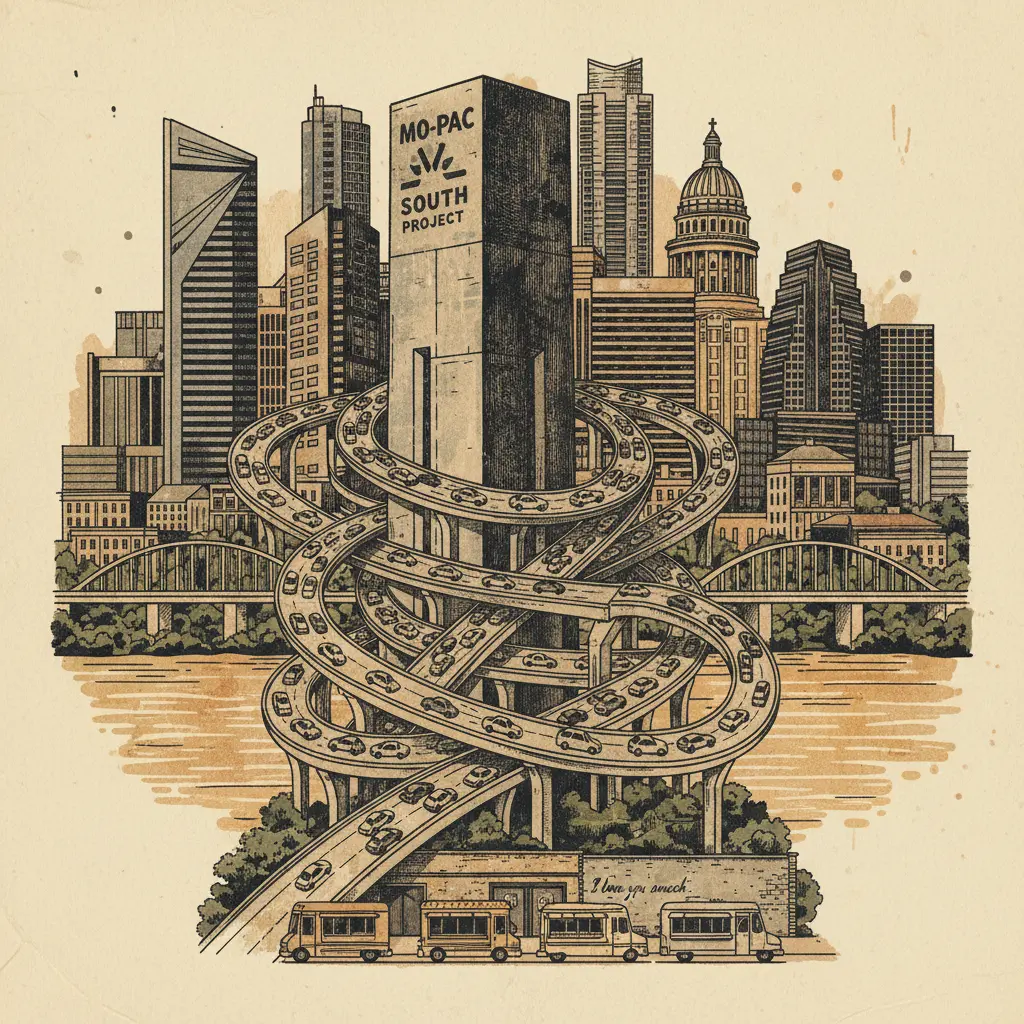
Time is a flat circle, and that circle is the loop of I-35. Just when you thought you could outrun the inevitable gridlock of Austin's highways, they announce another study, another expansion, another promise of a future where maybe, just maybe, you won't spend your life savings on gas and therapy. The MoPac South project, that shimmering mirage on the horizon, has released its environmental study. Prepare for a deep dive into bureaucratic optimism.
The Big Picture
The MoPac South project aims to add lanes to MoPac Expressway from Cesar Chavez Street down to Slaughter Lane. The goal? To alleviate traffic congestion. The reality? To temporarily delay the inevitable heat death of the universe by about six minutes. We're talking about years of construction, millions of dollars, and the faint hope that maybe, just maybe, you'll be able to get to that breakfast taco before they run out of tortillas.
By the Numbers
What Changed
The release of the environmental study marks a key milestone, signaling that the project is moving forward despite the chorus of existential dread from Austin residents. What changed? Political will, mostly. A desperate attempt to address a problem that may be beyond solving with asphalt and concrete. The forces at play? Population growth, suburban sprawl, and the collective delusion that cars are still a viable mode of transportation in a city that's rapidly turning into a parking lot.
Why It Matters
Because time is finite, and you're spending too much of it in your car. Because every minute spent in traffic is a minute stolen from your life. Because the faint promise of a slightly smoother commute is enough to keep us all going, even as the world burns. Go to the hearing, read the study, complain to your city council member. Or don't. The universe doesn't care either way. But at least you can say you tried before you succumb to the sweet embrace of gridlock.